
Which San Marcos Public Records Are Open
Access depends on the record set, not just the name of the person involved. The City of San Marcos is the custodian for municipal administration. San Diego County offices hold the longer-lasting land, clerk, court, and custody trails. California agencies hold statewide business, license, inmate, vital, and archive material. The table leads with the practical route, including the limits that keep an online result from serving as the full official file.
| Record set | Keeper | Online reach | How access works |
|---|---|---|---|
| Deeds and official filings | San Diego County ARCC Recorder | Real-property index, 1970 to present | Index online; mailed copy or public kiosk for images |
| Civil, criminal, family, mental health, and probate cases | San Diego Superior Court | Court Index, with no pre-1974 cases | Index online; clerk file, mail, or eligible Register of Actions purchase |
| Property and parcel data | ARCC Assessor | ParcelQuest and assessor maps | Online, phone information line, or office kiosk |
| Birth, death, and marriage certificates | ARCC and CDPH | No broad local name index | In person, online order, or mail; copy class depends on eligibility |
| City permits, contracts, and council files | San Marcos City Clerk or department | Selected city material | Email, phone, mail, in person, or request form |
| Current county custody | San Diego County Sheriff | Who's In Jail lookup | Online search may present a bot check |
Voter information follows election law rather than an ordinary agency request. The self-service tools and authorized file rules are treated separately in San Marcos voter records. Juvenile matters, sealed cases, protected addresses, adoption files, and many personal identifiers are not opened merely because an agency keeps them.
California Records Law in San Marcos
The California Public Records Act, Government Code sections 7920.000 et seq., applies to state and local agency records unless another law or a valid exemption controls. Government Code section 7922.535 generally gives an agency 10 calendar days to make its initial determination about whether responsive, disclosable material exists. Unusual circumstances can extend that determination period. Ten days is not a production deadline.
A focused request works best. Name the likely department, date range, address, parcel number, permit number, meeting, or document type. Agencies may charge direct duplication costs or a fee fixed by another statute, but ordinary search time is not a blank check for added fees. If a response cites an exemption, ask which portion can be segregated and released. A requester may also narrow the wording or pursue agency follow-up and available court remedies.
Lawful access. Open government files support civic review, family research, estate work, and fraud checks. Never use a location or identity detail to stalk, threaten, or harass someone.
San Marcos Recorder Index Access
The ARCC Official Records Index covers recorded real-property documents from 1970 to the present. Search by a grantor or grantee, the parties transferring or receiving an interest. The web result shows indexed facts, not the document image. A copy can be ordered for mail delivery, requested by mail, or viewed at an ARCC public kiosk without an appointment.
A mail order must give the document number, recorded year, at least one party name, and document type. Send it with a check or money order to San Diego Recorder/County Clerk, ATTN: Real Estate Records, P.O. Box 121750, San Diego, CA 92112-1750. The researched fee is $2 for the first page, $0.05 for each added page, and $1 to certify each document. Card payments add $2.50. ARCC prints online orders the next business day and sends them by regular mail, with a stated three to five business days for delivery after printing.
- Index
- A list of filing facts used to locate a record. It is not the document image.
- Certified copy
- A copy authenticated by the official custodian. Only ARCC, not its property-data vendor, issues certified copies.
- Custodian
- The office responsible for keeping and responding for a given record set.
- Exemption
- A rule that permits or requires an agency to withhold all or part of a record.
Note: ARCC does not record wills or hold probate files; those records belong to San Diego Superior Court after a death.
San Marcos Court Records Fields
The San Diego Superior Court Court Index can locate civil, criminal, domestic, mental health, and probate matters by party, case number, or district attorney number. Its typical result identifies the title, number, filing location, type, filed date, and parties. Charges and dispositions are not shown. The clerk's file is the official court record.
| Party search field | Input | Required | Official format notes |
|---|---|---|---|
| Case Type | Dropdown | No | Civil, Criminal, Domestic, Mental Health, or Probate |
| Case Location | Dropdown | No | Includes North County plus other county locations and Unknown-All |
| Party Type | Dropdown | No | Plaintiff/Petitioner or Defendant/Respondent for Civil or Domestic |
| Beginning and Ending Date Filed Year | Year | No | Narrows the filing span |
| Last Name or Business Name | Text | Practical yes | More characters improve speed and precision |
| First Name | Text | No | Helps separate similar names |
| Date of Birth | Date | No | Useful for criminal-name disambiguation |
The official party-name form displays these filters directly.
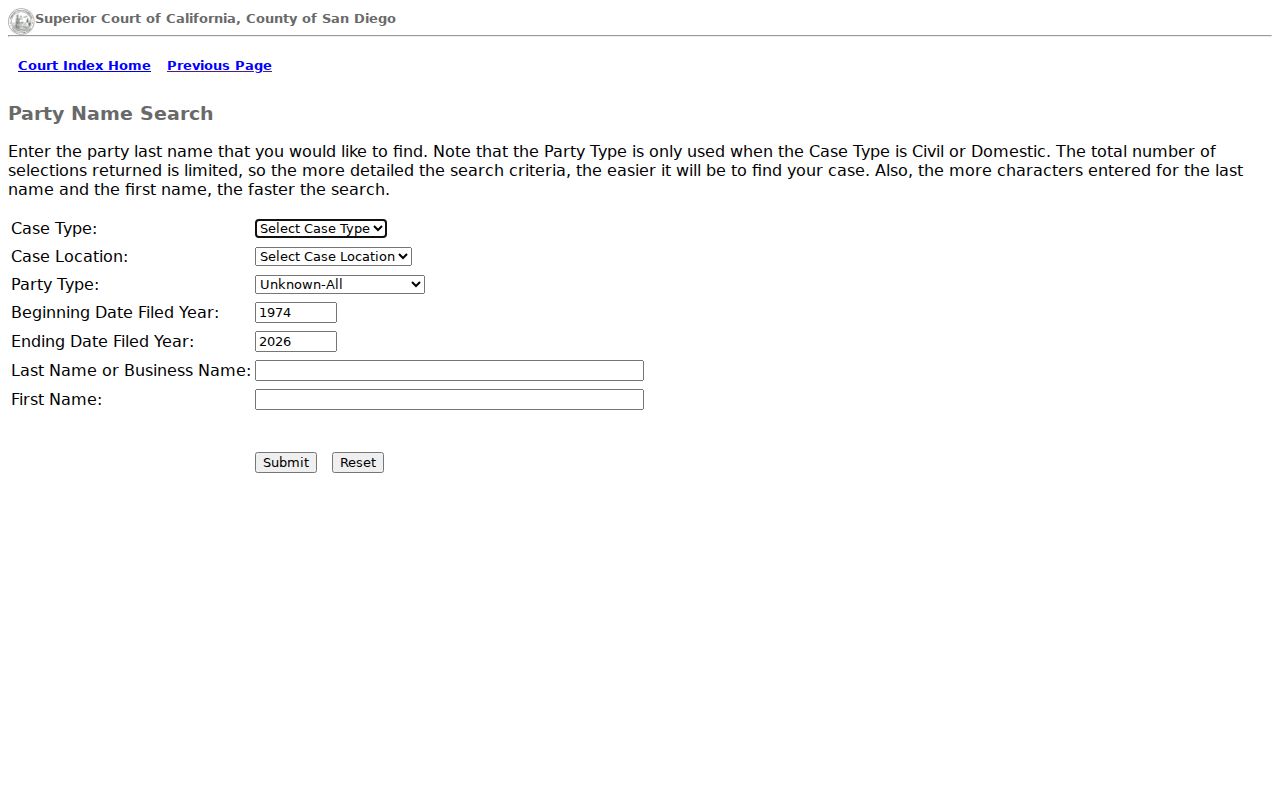
The image shows why a court lookup can be narrowed by case type, North County location, party role, filed years, name, and date of birth before a clerk-file request is made.
Older San Marcos Court Record Routes
The web index omits juvenile cases, traffic and minor-offense cases, infractions, and matters filed before 1974. Civil Limited and misdemeanor coverage may reach only 10 years at some court sites. For older cases, microfilm may be available at court locations for public use, but staff do not perform the research. That means the researcher must identify the right facility and review the film.
Criminal documents are viewed at the courthouse where the matter was heard or requested by mail. Some Civil, Small Claims, and Probate documents begun on or after January 1, 2008 can be purchased through the online Register of Actions. Some imaged Family documents filed on or after August 24, 2015 can also be bought online and mailed. The online index is a locator, not proof of a charge, outcome, or full case history.
San Marcos Property Records Channels
Property research splits across assessor, recorder, tax, and map systems. The ARCC property information page routes APNs, parcel traits, and maps to ParcelQuest. It also confirms that ownership and address facts are available by phone at (619) 236-3771 and on computer kiosks at ARCC offices. ParcelQuest permits 25 free searches in any 30-day period. More use may require a subscription, and reports or documents can carry vendor fees.
An APN is the Assessor's Parcel Number tied to a mapped tax parcel. ARCC says more than 29,128 assessor maps cover almost 1,001,029 parcels countywide. Maps show boundaries, dimensions, acreage, street widths, adjoining parcels, and recorded-map references, but not street addresses or ownership. Use the APN to reach those facts. SanGIS adds searches by address, APN, or intersection, while the County Survey Records System accepts geography, address, intersection, or record number.
The owner's mailing address may differ from the situs address, meaning the physical parcel location. The Treasurer-Tax Collector search accepts a parcel or bill number, mailing address, or unsecured bill number. This distinction can help an heir verify where a tax notice goes without claiming that the owner lives at either address.
Note: Certified property documents come only from ARCC, even when a vendor provides a paid electronic report or image.
San Marcos Records Offices and Portals
San Marcos is not the county seat, yet residents have a local ARCC branch for many recorder and clerk services. Service availability can vary by branch. City material stays with the City Clerk or the department that created it, while court files remain with San Diego Superior Court. These cards separate the most useful contact routes.
San Marcos City Clerk
1 Civic Center Drive
San Marcos, CA 92069
(760) 744-1050 ext. 3186
San Marcos Vital Records Boundaries
Birth and death events in San Diego County, plus marriages licensed and registered there, route to ARCC. Events or licenses from another county go to that county's recorder. ARCC asks requesters to wait three weeks after an event. A failed search results in a Letter of No Record, and the processing fee is not refunded.
Health and Safety Code section 103526 limits who can receive an authorized certified copy. Other eligible requesters may receive an informational copy marked as not valid to establish identity. The researched ARCC charge is $34 per birth certificate and $26 per death certificate. Birth orders can be made in person, by mail, or online through VitalChek. The online vendor adds a $12.95 handling fee and offers optional $19 expedited delivery. An authorized mail request needs a sworn statement and notarized Certificate of Acknowledgement. A confidential marriage copy is limited to a registrant or a person with a court order.
The ARCC birth certificate page sets out the identity, sworn-statement, and order requirements.
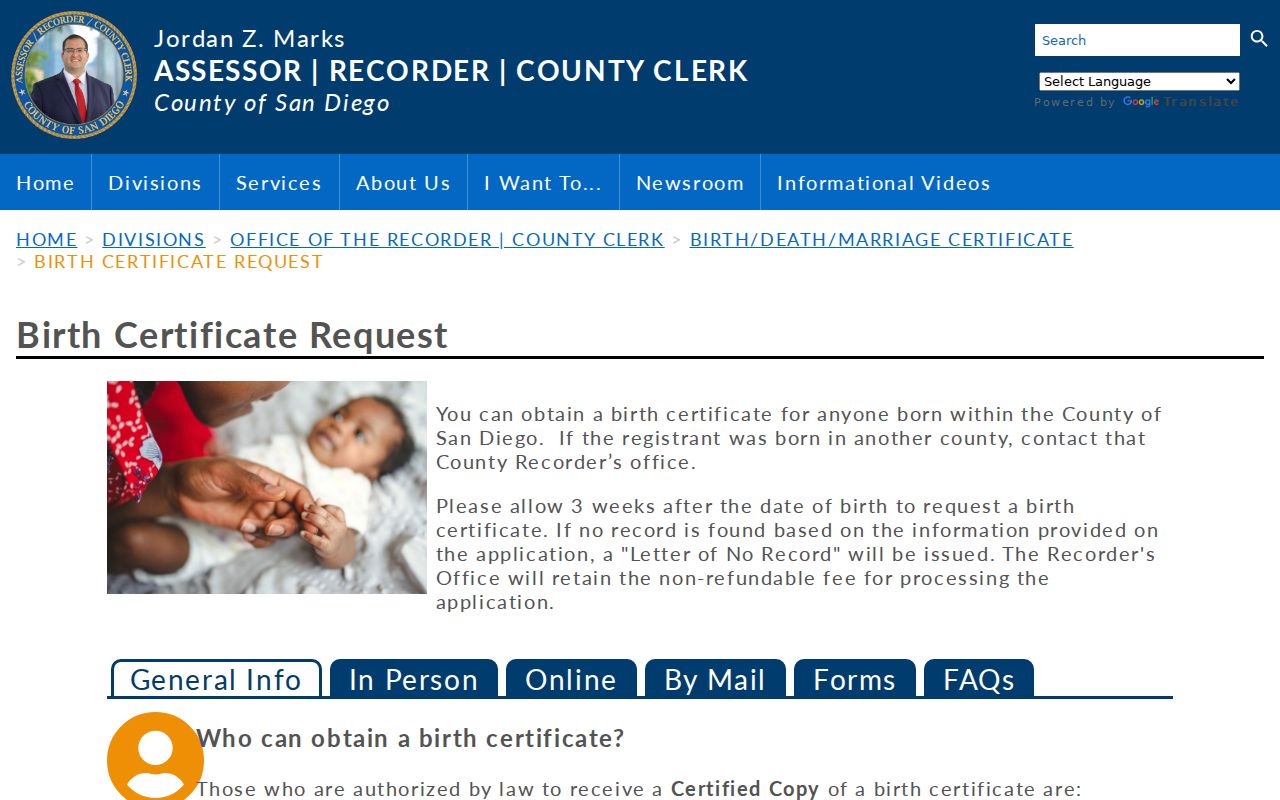
The captured source makes the key distinction visible: a certificate request is a controlled copy process, not an open name index.
San Marcos Custody and Registry Records
Local custody is handled by the San Diego County Sheriff. The official Who's In Jail tool covers current county custody, though its bot check may block some sessions. Sheriff facility abbreviations include SDCJ, GBDF, EMRF, VDF, LCDRF, SBDF, and RMDF. Those codes refer to county detention sites, not separate case outcomes.
State prison custody belongs to the California Department of Corrections and Rehabilitation. Federal custody from 1982 to the present can be checked through the Bureau of Prisons by first, middle, and last name, with optional race, sex, and age filters. The California Megan's Law registry is operated under Penal Code section 290.46 and has strict use limits. It is not a tool for threats, harassment, or punishment. A custody result should be checked against the court clerk file when the case history matters.
City Lines Change San Marcos Records
A San Marcos mailing address does not always prove that the property lies inside the incorporated city. The city itself tells code-compliance users to verify city limits and contact San Diego County for an unincorporated address. This geography affects the custodian for permit, code, service, and local administrative files.
For an uncertain address, confirm the parcel in SanGIS or assessor data before filing. Then ask the city department if the parcel is within its service area. County, school, special district, and postal boundaries may not match. This is especially relevant near Twin Oaks Valley, Lake San Marcos, San Elijo Hills, Discovery Hills, Santa Fe Hills, and the Vista, Escondido, or Carlsbad edges. The filing agency, not the place name on the envelope, controls where the record will be found.
San Marcos Records Request Portal Trail
San Diego County's NextRequest listings begin March 21, 2024. County guidance says closed or released requests leave the platform three years after closure, so the browse screen is not a permanent archive of every past request. The new-request form can accept an optional date range, address, APN, and permit number. An account is not required before submission; the email process creates one.
The San Diego County request form shows those property and timeframe fields.
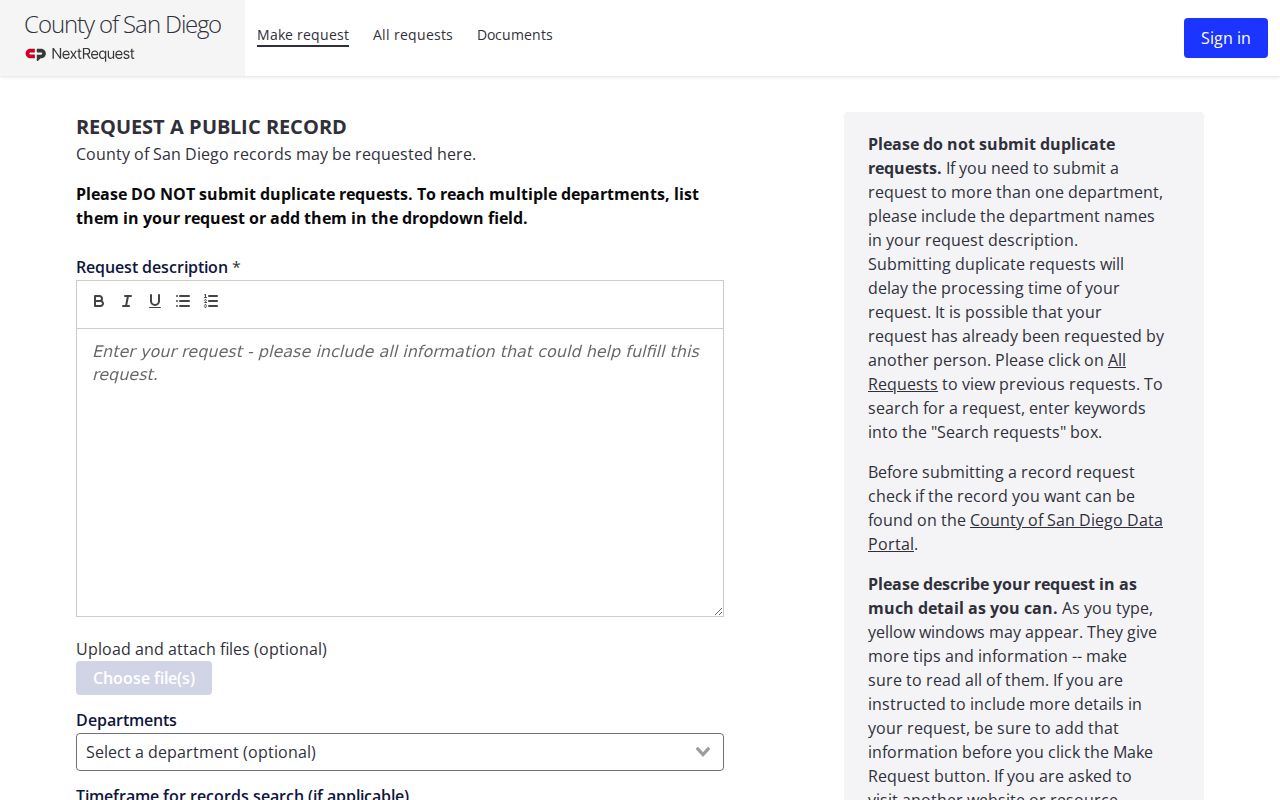
The screenshot illustrates why a narrow date span, street address, APN, or permit number can route a San Marcos request more precisely than a broad name alone.
File a San Marcos Public Records Request
The correct request channel depends on who made or holds the file. San Marcos accepts City Clerk requests by email at Cityclerk@sanmarcosca.gov, by phone, by mail, in person, or through its published request PDF. San Diego County uses NextRequest and its county request hub. A court-file request goes through the court's own access route, not CPRA.
- Name the custodian. Decide whether the file is a city action, county record, court file, or state record. Send it to the office that created or keeps it.
- Check the index first. Use the official deed, court, parcel, custody, business, or license portal when one exists. Save the number, date, and location that identify the file.
- Describe the record. Give a useful date range, subject, address, APN, permit number, meeting, case number, or document type. Ask for an electronic copy when that format exists.
- Track the determination. The usual 10-day CPRA period covers the initial disclosure decision. It does not promise that all records will be produced by day ten.
- Review fees and redactions. Ask for an estimate before a large copy order. If material is withheld, request the cited exemption and any reasonably segregable portion.
Records that are already published may be answered with a portal link. If an index gives only filing data, use the custodian's copy route. For pre-digital material, shift to a counter, kiosk, microfilm reader, archive, or library rather than repeating the same web search.
Closed San Marcos Records and Safety
California law closes or narrows several identity-rich sets. Common limits include sealed and expunged cases, juvenile files, adoption material, confidential marriages, protected voter data, DMV personal data, Social Security numbers, certain law-enforcement investigations, medical information, and addresses protected through Safe at Home. A custodian may redact protected parts while releasing the rest.
Recorded filings can still expose enough data for fraud. ARCC's free Owner Alert sends notice of certain real-estate filings and can help a property owner spot an unexpected record. California residents also gained the statewide DROP route in 2026 for one deletion request to active registered data brokers, with broker processing due to begin August 1, 2026. DROP affects broker-held copies, not an official record that the law requires an agency to retain.
Use official sources to verify suspicious demands. ARCC's copy schedule helps expose high-priced deed-copy mailers, and the State Controller says an unclaimed-property search and claim carry no fee. Identity theft can be reported through the California Department of Justice and San Diego County District Attorney resources. Immediate threats belong with law enforcement.